


Choosing Gynaecomastia Surgeon UK: Ensuring Safe, Expert Care
To effectively choose gynaecomastia surgeon uk, patients must prioritize specific qualifications and safety standards for a successful outcome. This guide details essential criteria, including verifying a surgeon’s GMC Specialist Register status for Plastic Surgery, confirming FRCS (Plast) qualification, and assessing professional memberships like BAAPS or BAPRAS. Understanding facility accreditation, evaluating patient reviews, and reviewing before and after photos are also crucial steps. A meticulous approach helps patients choose a gynaecomastia surgeon in the UK who can deliver a natural, masculine chest contour safely.
Mr. Khurram Khan is a fully UK-trained Consultant Plastic Reconstructive and Aesthetic Surgeon, listed on the GMC Specialist Register for Plastic Surgery. His practice focuses on safe, natural outcomes, combining NHS consultant-level expertise with private patient care for gynaecomastia correction.
To explore your options, contact us to schedule your consultation. You can also reach us via: Book your gynaecomastia consultation
Why Choosing the Right Gynaecomastia Surgeon Matters
Selecting a surgeon for gynaecomastia correction is a critical decision. The right specialist ensures a safe procedure and an outcome that aligns with your aesthetic goals, achieving a natural, masculine chest contour. An incorrect choice can lead to unsatisfactory results, complications, and revision surgery. A methodical approach to how you choose gynaecomastia surgeon uk is essential.
Understanding Gynaecomastia and Your Goals
Gynaecomastia is a common condition characterised by enlarged male breast tissue. It can be caused by hormonal imbalances, medications, or genetics, affecting men of all ages. The condition can involve excess glandular tissue, excess fatty tissue, or both.
Gynaecomastia’s physical appearance can impact self-confidence, affecting choices in clothing, social activities, and quality of life. The goal of male breast reduction surgery is to remove this excess tissue, creating a flatter, firmer, and better-contoured chest. A successful outcome restores confidence and body image.
Essential Qualifications: Your Surgeon’s Credentials Checklist
In the UK, the titles ‘cosmetic surgeon’ and ‘plastic surgeon’ are not equally protected. Patients must verify a surgeon’s qualifications. A credentials checklist provides an objective measure of their training and professional standards.
The Non-Negotiable: GMC Specialist Register for Plastic Surgery
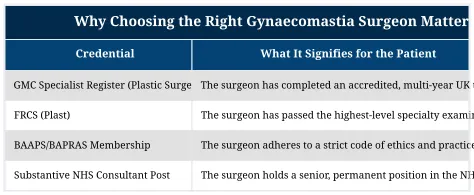
The most important credential is entry on the General Medical Council (GMC) Specialist Register for Plastic Surgery. This is the official record of UK doctors legally entitled to work in a substantive consultant post in the NHS. This register confirms a surgeon has completed a multi-year, accredited training programme in plastic, reconstructive, and aesthetic surgery. It distinguishes a fully qualified consultant plastic surgeon from a doctor with a general medical background who performs cosmetic procedures.
You can verify any surgeon’s status by searching their name on the public GMC register online.
Beyond the Basics: FRCS (Plast) and Professional Memberships
Beyond the GMC register, look for the FRCS (Plast) qualification. It signifies a surgeon has passed the Intercollegiate Specialty Examination in Plastic Surgery, a demanding assessment of their surgical knowledge and clinical skills. It is a prerequisite for completing specialist training in the UK.
Membership in professional bodies like the British Association of Aesthetic Plastic Surgeons (BAAPS) and the British Association of Plastic, Reconstructive and Aesthetic Surgeons (BAPRAS) is also important. These organisations only admit surgeons on the GMC Specialist Register who adhere to high standards of patient care, ethical practice, and continuous professional development.
View data as table
| Credential | What It Signifies for the Patient |
|---|---|
| GMC Specialist Register (Plastic Surgery) | The surgeon has completed an accredited, multi-year UK training programme in plastic surgery. This is the most critical qualification for safety and expertise. |
| FRCS (Plast) | The surgeon has passed the highest-level specialty examination in plastic surgery, demonstrating comprehensive knowledge and skill. |
| BAAPS/BAPRAS Membership | The surgeon adheres to a strict code of ethics and practice, is committed to ongoing education, and is recognised by their peers as a specialist. |
| Substantive NHS Consultant Post | The surgeon holds a senior, permanent position in the NHS, often dealing with complex reconstructive cases, which demonstrates a high level of trust and experience. |
Experience & Specialisation: Finding a Gynaecomastia Expert
While formal qualifications are the foundation, a surgeon’s specific experience shapes the final result. Gynaecomastia surgery requires an understanding of male chest anatomy to sculpt a natural, masculine contour, not just remove tissue.
Why Dedicated Gynaecomastia Experience Matters
A surgeon who regularly performs male breast reduction is adept at handling different gynaecomastia types, from purely glandular to mixed tissue. They have refined techniques for minimising scars, positioning the nipple-areola complex correctly, and blending the surgical area with surrounding chest muscles. Look for a surgeon whose practice includes many gynaecomastia cases, which indicates familiarity and skill with the procedure’s challenges.
The Value of Reconstructive Expertise for Natural Outcomes
A surgeon with a background in reconstructive surgery, often from an NHS consultant post, brings a valuable perspective to aesthetic procedures. Reconstructive surgery restores form and function, requiring an understanding of anatomy and tissue behaviour. This foundation informs a surgical approach that respects underlying structures to create aesthetically pleasing results.
This expertise is crucial in complex cases, such as significant tissue excess or adolescent gynaecomastia, where the surgeon must account for future development. A surgeon with a specialised surgical fellowship and reconstructive experience can deliver technically sound, balanced, and natural-looking results.
Patient Safety & Facility Standards: What to Look For
Your safety depends on the surgeon, the surgical facility, and the quality of care provided.
CQC Registration and Accredited Surgical Facilities
Any private hospital or clinic in the UK where surgery is performed must be registered with the Care Quality Commission (CQC). The CQC is the independent regulator of health and social care in England, inspecting facilities to ensure they meet fundamental standards of quality and safety. Confirm your procedure will take place in a CQC registered facility. This ensures the hospital has the appropriate staffing, equipment, and safety protocols.
Transparent Consultation and Aftercare
Your initial contact should lead to a consultation directly with the consultant surgeon, not a salesperson or patient coordinator. During this consultation, the surgeon should conduct a thorough assessment, discuss your goals, and explain the recommended procedure, including potential risks and complications.
The aftercare plan is equally important. Understand the follow-up schedule, who to contact with concerns, and what support is available during recovery. Comprehensive post-operative care is crucial for a successful recovery.
Evaluating Patient Feedback & Your Consultation Process
Beyond credentials and facilities, the patient experience and your rapport with the surgeon are important. Reviews and the consultation are valuable for this.
Interpreting Patient Reviews and Before & After Photos
Independent platforms like RealSelf and I Want Great Care can provide insight into a surgeon’s practice. When reading patient reviews, look for consistent themes regarding the surgeon’s communication, staff professionalism, and satisfaction with results. Detailed testimonials are often more informative than simple star ratings.
When viewing before and after photos, assess them critically. Look for results on patients with a similar body type and severity of gynaecomastia to your own. The outcomes should look natural, with well-hidden scars and a smooth chest contour. A gallery should showcase a variety of cases and demonstrate consistent results.
Key Questions to Ask During Your Gynaecomastia Consultation
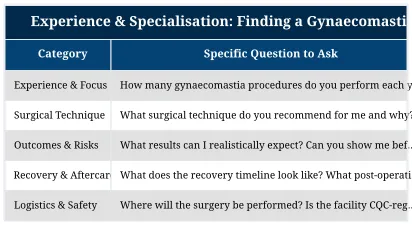
The consultation process is your opportunity to determine if the surgeon is a good fit. A prepared list of questions helps you make a confident decision.
View data as table
| Category | Specific Question to Ask |
|---|---|
| Experience & Focus | How many gynaecomastia procedures do you perform each year? Do you have experience with cases like mine (e.g., adolescent, significant skin excess)? |
| Surgical Technique | What surgical technique do you recommend for me and why? Where will the incisions be placed? Will you use liposuction, gland excision, or both? |
| Outcomes & Risks | What results can I realistically expect? Can you show me before and after photos of your own patients? What are the specific risks of this procedure? |
| Recovery & Aftercare | What does the recovery timeline look like? What post-operative care and follow-up appointments are included? Who is my point of contact if I have concerns? |
| Logistics & Safety | Where will the surgery be performed? Is the facility CQC-registered? Who will administer the anaesthesia? |
Your Journey to a Confident Chest: Next Steps
Your diligence in how you choose gynaecomastia surgeon uk will be reflected in the quality and safety of your outcome. The goal is to find a surgeon with the technical skill to achieve your aesthetic goals in a safe, supportive environment.
To explore your options for male breast reduction with a qualified consultant plastic surgeon, Book your gynaecomastia consultation to discuss your needs.
Conclusion
Choosing a gynaecomastia surgeon depends on three factors: verifiable qualifications, specific surgical experience, and a commitment to patient safety. The most critical factor is confirming your surgeon is on the GMC Specialist Register for Plastic Surgery. Seek a professional with a portfolio in male chest contouring and a background in reconstructive surgery for a natural aesthetic. Ensure they operate in a CQC-registered facility and that you feel comfortable and heard during the consultation.
To start with an experienced consultant, contact us or Book your gynaecomastia consultation for a personalised assessment.
Frequently Asked Questions
What’s the difference between a ‘cosmetic surgeon’ and a plastic surgeon for male breast reduction?
A Consultant Plastic Surgeon is listed on the General Medical Council (GMC) Specialist Register for Plastic Surgery, confirming they have completed a rigorous, multi-year, accredited UK training programme. They will also hold the qualification FRCS (Plast). A generic ‘cosmetic surgeon’ may not have this official specialist training, making the GMC register a critical safety benchmark for patients.
Why does it matter which hospital my gynaecomastia surgery is performed in?
Your surgeon must have operating privileges in a hospital that is registered and inspected by the Care Quality Commission (CQC). This is the independent regulator of health and social care in England, and its registration ensures the facility meets mandatory national standards for safety, equipment, and clinical governance. Operating outside a CQC-regulated hospital poses significant patient safety risks.
How should I evaluate a surgeon’s before and after photos for gynaecomastia?
Look for consistency in results across a range of different body types, not just one or two ideal examples. Pay close attention to the naturalness of the chest contour, the subtlety and placement of any scars, and whether the nipple-areola complex is well-positioned and sized. A strong portfolio demonstrates the surgeon’s ability to tailor the procedure to individual anatomy for a balanced, masculine outcome.
Are there special considerations when seeking surgery for adolescent gynaecomastia?
Yes, this requires specific expertise. A surgeon must carefully assess if the condition has stabilised following puberty to minimise the chance of recurrence. Furthermore, the surgeon should have demonstrable experience in managing the unique psychological and familial dynamics involved when treating younger patients, ensuring a sensitive and supportive consultation process.
What is the most important qualification when I choose gynaecomastia surgeon uk?
The single most important, non-negotiable qualification is their entry on the GMC’s Specialist Register for Plastic Surgery. Beyond this, membership in professional bodies like the British Association of Plastic, Reconstructive and Aesthetic Surgeons (BAPRAS) or BAAPS indicates a surgeon’s commitment to the highest ethical and professional standards in the UK.
How can I check if a surgeon is on the GMC Specialist Register?
You can verify any UK doctor’s credentials for free by searching their name or GMC number on the official General Medical Council online register. A surgeon’s qualifications, including their FRCS (Plast) status and the date they joined the specialist register, should be transparently listed and easily verifiable through this public resource.


