
360 Lower Body Lift: Comprehensive Contouring After Weight Loss
A 360 lower body lift is a comprehensive body contouring procedure designed to remove significant excess skin and tissue following massive weight loss. This circumferential lipectomy addresses the abdomen, hips, outer thighs, and buttocks simultaneously, creating a more harmonious and proportionate silhouette. The article details who is an ideal candidate, the surgical journey involved, and the recovery process. It emphasizes that this procedure is a reconstructive step, not a weight loss solution, aiming to improve comfort and body shape for individuals post-bariatric surgery or significant diet and exercise.
Mr. Khurram Khan, a UK-trained Consultant Plastic Reconstructive and Aesthetic Surgeon, specialises in post massive weight loss body contouring. His approach prioritises natural, balanced outcomes, combining reconstructive expertise with aesthetic precision for patients seeking significant contour refinement.
To explore your options, contact us to schedule your consultation. You can also reach us via: Request a body contour consultation
What is a 360 Lower Body Lift (Circumferential Lipectomy)?
A 360 lower body lift is a body contouring procedure addressing loose, excess skin and tissue around the lower torso. It is most common for individuals after massive weight loss from diet and exercise or bariatric surgery. The goal is not weight reduction but removing redundant skin to improve body shape, comfort, and function.
This surgery combines procedures, targeting the abdomen, waist, hips, outer thighs, and buttocks in one continuous operation. Addressing the entire lower body circumference creates a more harmonious and proportionate contour than separate procedures might achieve.
Understanding Circumferential Lipectomy
The medical term is circumferential lipectomy. ‘Circumferential’ refers to the 360-degree incision and tissue removal, which runs around the body like a belt. ‘Lipectomy’ means surgical removal of fatty tissue, performed with excess skin removal. This approach allows a plastic surgeon to lift and tighten the skin of the abdomen, thighs, and buttocks simultaneously, re-draping the skin over the patient’s smaller frame.
Who is an Ideal Candidate?
Ideal candidates have completed significant weight loss and seek to address resulting skin laxity. The procedure is a final, reconstructive step to align a person’s appearance with their healthier state. A consultation with a plastic surgeon is essential to determine suitability.
Several factors are considered. Patients must be in good health, without medical conditions that could impair healing or increase surgical risk. Patients need realistic expectations about the outcome, including a permanent scar and lengthy recovery.
Key Considerations for Eligibility
- Weight Stability: Candidates must have a stable weight for at least six months. This ensures long-lasting results and that the body is nutritionally prepared for surgery.
- Nutritional Health: Good nutrition is vital for healing. Post-bariatric surgery patients may need assessment for nutritional deficiencies to ensure effective recovery.
- Non-Smoker: Smoking impairs blood flow and healing, increasing risks of complications like tissue death (necrosis) and poor scarring. Candidates must stop smoking well before and after surgery.
- Psychological Readiness: The procedure requires mental and emotional preparation. Candidates should understand the recovery process.
The Surgical Journey: What a Circumferential Body Lift Involves
A circumferential body lift requires careful planning between the patient and surgeon. The procedure is performed under general anaesthesia and typically involves an overnight hospital stay. Its complexity lies in integrating multiple lifts into one operation for a balanced result.
Combining Abdominoplasty, Thigh, and Buttock Lifts
The operation uses an integrated, continuous technique, not three separate procedures. The incision allows the surgeon to perform an abdominoplasty to tighten the stomach, a lateral thigh lift to smooth the outer thighs, and a buttock lift to elevate and reshape the buttocks. This excess skin removal addresses the “deflated” appearance common after massive weight loss.
Procedure Steps and Incision Planning
The incision follows a “belt” pattern around the lower torso, positioned to be concealed by most underwear and swimwear. The surgeon removes a large ellipse of skin and underlying fat from this entire circumference. The remaining skin from the upper abdomen, back, and buttocks is pulled down, and thigh skin is pulled up, before the incisions are closed. This re-draping and tightening creates the improved contour.
View data as table
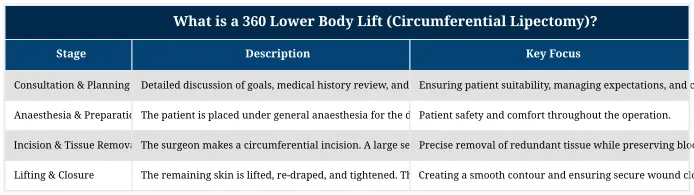
| Stage | Description | Key Focus |
|---|---|---|
| Consultation & Planning | Detailed discussion of goals, medical history review, and physical examination. The surgeon marks the planned incisions on the body. | Ensuring patient suitability, managing expectations, and creating a precise surgical plan. |
| Anaesthesia & Preparation | The patient is placed under general anaesthesia for the duration of the procedure. | Patient safety and comfort throughout the operation. |
| Incision & Tissue Removal | The surgeon makes a circumferential incision. A large segment of excess skin and fat is excised from the abdomen, hips, back, and buttocks. | Precise removal of redundant tissue while preserving blood supply to the remaining skin. |
| Lifting & Closure | The remaining skin is lifted, re-draped, and tightened. The incisions are closed in layers with sutures. Surgical drains may be placed. | Creating a smooth contour and ensuring secure wound closure for optimal healing. |
Mr. Khan’s Approach to Post-Weight Loss Body Contouring
Choosing a surgeon for post-massive weight loss body contouring requires understanding the unique challenges of these procedures. Mr. Khurram Khan, a UK-trained Consultant Plastic, Reconstructive and Aesthetic Surgeon, approaches these cases with a reconstructive philosophy to restore form and function.
The Importance of Reconstructive Expertise
Procedures after major weight loss are reconstructive. The goal is to rebuild the body’s framework, altered by significant volume changes. Mr. Khan’s background as an NHS consultant dealing with complex reconstructive challenges provides a foundation for these operations. This experience is crucial for managing tissue handling, ensuring blood supply, and planning for safe healing, which are paramount in post-bariatric surgery. According to the British Association of Aesthetic Plastic Surgeons (BAAPS), these procedures require a high level of surgical expertise.
Achieving Natural, Balanced Results
The goal is a natural result. This involves sculpting and reshaping underlying tissues to create harmonious proportions. Mr. Khan’s philosophy is to create balanced outcomes that avoid an “over-operated” appearance. Incision planning aims to place scars discreetly, and surgical technique is used to create smooth transitions between treated areas. The focus is on finalizing the patient’s transformation with a contour that reflects their renewed health.
Recovery and Long-Term Results After a Circumferential Lipectomy
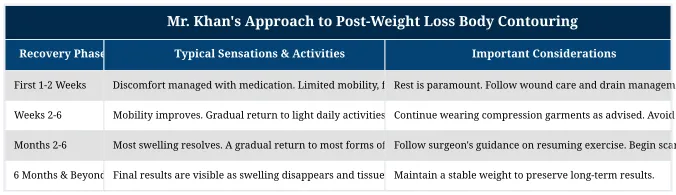
Recovery from a circumferential lipectomy is gradual and requires adherence to post-operative instructions. The body needs ample time to heal. Patients wear a compression garment for several weeks to reduce swelling and support contoured tissues.
Navigating the Recovery Period
Initial recovery involves limited mobility. Walking is encouraged soon after surgery to promote circulation, but strenuous activity is restricted for many weeks. Discomfort is expected and managed with prescribed medication. Surgical drains remove excess fluid and are typically removed within one to two weeks, depending on progress. Swelling and bruising are normal and subside over several months as final results appear.
View data as table
| Recovery Phase | Typical Sensations & Activities | Important Considerations |
|---|---|---|
| First 1-2 Weeks | Discomfort managed with medication. Limited mobility, focus on short walks. Assistance needed with daily tasks. Drains and compression garments are in use. | Rest is paramount. Follow wound care and drain management instructions. Avoid lifting or straining. |
| Weeks 2-6 | Mobility improves. Gradual return to light daily activities and desk work. Swelling remains but begins to decrease. | Continue wearing compression garments as advised. Avoid strenuous exercise and heavy lifting. Do not over-exert yourself. |
| Months 2-6 | Most swelling resolves. A gradual return to most forms of exercise is typically possible. Scars begin to mature and fade. | Follow surgeon’s guidance on resuming exercise. Begin scar care protocols if recommended. |
| 6 Months & Beyond | Final results are visible as swelling disappears and tissues settle. Scars continue to fade and soften over the next year or more. | Maintain a stable weight to preserve long-term results. |
Maintaining Your New Contour
Lower body lift results are long-lasting. The outcome’s longevity depends on the patient’s lifestyle. Maintaining a stable weight through diet and exercise ensures the new body contour remains. Significant weight fluctuations can stretch the skin, compromising the result.
Is a 360 Lower Body Lift Right for You?
Deciding to undergo a 360 lower body lift is a personal choice and a significant commitment. For the right candidate, it can be a life-changing procedure that is the final step in a weight loss journey, improving comfort, confidence, and quality of life. A clear understanding of the procedure, recovery, and expected results is key.
Taking the Next Step Towards Body Contouring
The most important step is a consultation with a qualified Consultant Plastic Surgeon. This allows for a personal assessment of your anatomy and a discussion of your goals. If you are considering body contouring surgery after massive weight loss, Request a body contour consultation to explore your options.
Conclusion
A circumferential body lift is a reconstructive procedure that addresses functional and aesthetic challenges from excess skin after massive weight loss. The critical decision is selecting a surgeon whose expertise aligns with the surgery’s complexity. A background in reconstructive plastic surgery is invaluable, ensuring the surgeon can manage reshaping tissue while prioritising safety and natural results. To learn more about the full range of body contouring procedures, contact us. For a personalised assessment, Request a body contour consultation with Mr. Khan.
Frequently Asked Questions
How long must my weight be stable before a circumferential body lift?
Surgeons generally require your weight to be stable for at least 6 to 12 months before considering this procedure. This ensures that your results will be long-lasting and that your body is in an optimal state for healing. According to guidelines from bodies like the British Association of Aesthetic Plastic Surgeons (BAAPS), weight stability is a key factor in patient safety and surgical success.
Will I have surgical drains after a 360 lower body lift?
Yes, surgical drains are almost always used in a 360 lower body lift. These small tubes are placed under the skin to prevent the buildup of fluid (seroma) in the large surgical area. They are a crucial part of the initial recovery process and are typically removed by your surgical team a week or two after the operation, once the fluid output has decreased to a safe level.
How is a circumferential lipectomy different from a standard tummy tuck?
A standard tummy tuck, or abdominoplasty, primarily addresses excess skin and muscle laxity on the front of the abdomen. A circumferential lipectomy is far more extensive; its incision goes all the way around the torso, allowing for the removal of loose skin and lifting of the abdomen, outer thighs, hips, and buttocks in a single, integrated procedure.
Where will the scar from a lower body lift be located?
The scar from a lower body lift is a continuous line that runs around the entire circumference of your lower torso, similar to the line of a low-slung belt. Mr. Khan strategically places this incision as low as possible so that it can typically be concealed by most underwear and swimwear. The final appearance of the scar will mature and fade over the course of a year or more.
Can this procedure improve physical symptoms like skin rashes or chafing?
Yes, for many massive weight loss patients, a key benefit is functional improvement. By removing the large folds of excess skin where moisture and bacteria can become trapped, the procedure can significantly reduce or eliminate chronic skin irritation, rashes (intertrigo), and chafing. This often makes daily activities and exercise more comfortable and hygienic.
What kind of compression garment is needed after a circumferential body lift?
After surgery, you will be required to wear a specialised medical-grade compression garment that covers the entire treatment area, from the upper abdomen to the mid-thighs. This garment must be worn continuously for several weeks as directed by your surgeon. Its purpose is to minimise swelling, support the healing tissues, and help your skin adapt to its new, tighter contours.