Post Bariatric Plastic Surgery Consultation: Navigating Your Body Contouring Journey
A post bariatric plastic surgery consultation provides a comprehensive assessment for individuals considering body contouring after significant weight loss. This crucial meeting establishes realistic surgical goals, evaluates your overall health, and outlines a personalised surgical plan for excess skin removal. Patients learn how to prepare, what to expect during the patient assessment, and the importance of weight stability for optimal outcomes. The consultation clarifies procedure options and helps you understand the journey towards achieving your desired body shape safely and effectively.
Mr. Khurram Khan is a UK-trained Consultant Plastic Reconstructive and Aesthetic Surgeon, specialising in post massive weight loss body contouring. His expertise ensures a reconstructive approach, prioritising safe and natural outcomes for complex aesthetic challenges.
To explore your options, contact us to schedule your consultation. You can also reach us via: Request a body contour consultation
What to Expect: Your Post-Bariatric Plastic Surgery Consultation Explained
A post bariatric plastic surgery consultation is a medical assessment to determine your suitability for body contouring procedures after significant weight loss. It is a conversation with a specialist surgeon to establish realistic goals, evaluate your health status, and create a safe, personalised surgical plan for excess skin removal.
The consultation involves a detailed review of your weight loss history, nutritional status, and how excess skin affects your daily life, from physical discomfort to challenges with clothing and hygiene. The surgeon’s objective is to understand your anatomy and aspirations to recommend the most effective procedures.
The Primary Goal of Your Initial Assessment
The surgeon will assess your health to confirm you are a candidate for surgery. This includes ensuring your weight has been stable for at least six months, which is vital for predictable and lasting results.
The consultation aligns your expectations with achievable surgical outcomes. Through a physical examination and discussion, the surgeon will explain which procedures can best address your areas of concern. This meeting is your opportunity to build a relationship with your surgeon, ask questions, and receive an overview of the proposed surgical plan, including recovery and costs.
Preparing for Your Body Contouring Consultation: Key Steps
Gathering Your Medical History and Weight Loss Journey Details
Before your appointment, compile a list of your current and past medical conditions, previous surgeries (especially your bariatric procedure), and all medications and supplements you take, including dosages. Be prepared to discuss your weight loss timeline: when you had surgery, how much weight you lost, and how long your weight has been stable. This information is critical for assessing surgical risk and planning a safe procedure. The level of detail a surgeon requires for your safety is a key factor in how to choose your surgeon.
Clarifying Your Aesthetic Goals and Asking the Right Questions
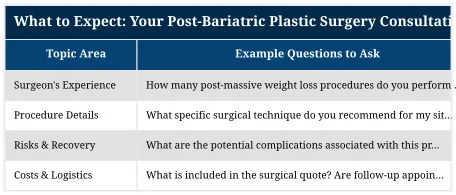
Clarify your specific objectives. Identify which areas of your body concern you most and whether your goals relate to comfort, function, appearance, or a combination. It is helpful to write these down, along with a list of questions for your surgeon. The table below provides examples.
View data as table
| Topic Area | Example Questions to Ask |
|---|---|
| Surgeon’s Experience | How many post-massive weight loss procedures do you perform each year? Are you on the GMC Specialist Register for Plastic Surgery? |
| Procedure Details | What specific surgical technique do you recommend for my situation and why? Where will the incisions be located and what will the scars look like? |
| Risks & Recovery | What are the potential complications associated with this procedure? What is the typical recovery timeline, and when can I expect to return to work and normal activities? |
| Costs & Logistics | What is included in the surgical quote? Are follow-up appointments covered? Where will the surgery take place? |
What Happens During Your Consultation? A Step-by-Step Guide
Your post bariatric plastic surgery consultation is a structured process involving an in-depth discussion and a physical examination, culminating in a preliminary surgical plan tailored to your needs.
The Initial Discussion: Health, Lifestyle, and Expectations
Mr. Khan will review the medical history you prepared, focusing on your bariatric surgery and weight stability. He will ask about your lifestyle, including diet, exercise habits, and smoking status, as these factors impact healing and surgical outcomes. Share your aesthetic goals and the functional problems caused by excess skin, such as chafing, rashes, or difficulty with physical activity.
Physical Examination and Procedure Options
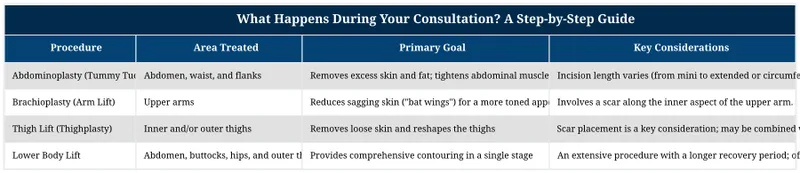
A private physical examination follows the discussion. Mr. Khan will assess areas of concern, evaluating skin quality, elasticity, and the location of excess skin and residual fat. This assessment determines the most appropriate procedure options. He will explain the surgical techniques for each area, such as an abdominoplasty or a brachioplasty. You will discuss combining procedures versus staging them over time, weighing the benefits against the complexities of a longer surgery and recovery.
View data as table
| Procedure | Area Treated | Primary Goal | Key Considerations |
|---|---|---|---|
| Abdominoplasty (Tummy Tuck) | Abdomen, waist, and flanks | Removes excess skin and fat; tightens abdominal muscles | Incision length varies (from mini to extended or circumferential); requires navel repositioning. |
| Brachioplasty (Arm Lift) | Upper arms | Reduces sagging skin (“bat wings”) for a more toned appearance | Involves a scar along the inner aspect of the upper arm. |
| Thigh Lift (Thighplasty) | Inner and/or outer thighs | Removes loose skin and reshapes the thighs | Scar placement is a key consideration; may be combined with liposuction. |
| Lower Body Lift | Abdomen, buttocks, hips, and outer thighs | Provides comprehensive contouring in a single stage | An extensive procedure with a longer recovery period; offers dramatic results. |
Why Choose a Reconstructive Specialist for Post-Weight Loss Surgery?
Body contouring after massive weight loss is complex reconstructive plastic surgery. The changes to skin, fat, and underlying tissues are profound. A surgeon with a background in reconstructive techniques, like those from the NHS, is equipped to handle these complexities and approaches excess skin removal with a focus on both form and function.
The Advantage of Reconstructive Expertise in Body Contouring
A surgeon with a reconstructive surgery foundation has the skills to address post-bariatric challenges. This expertise includes advanced tissue handling, intricate suturing to minimise scarring, and restoring anatomical structure. As a UK-trained Consultant Plastic and Reconstructive Surgeon, Mr. Khurram Khan’s reconstructive expertise is applied to achieve natural, balanced results. This background is important for managing large-volume skin removal and ensuring optimal healing, a core principle of organisations like the British Association of Plastic, Reconstructive and Aesthetic Surgeons (BAPRAS).
Prioritising Weight Stability and Long-Term Results
A specialist ensures correct surgical timing. Operating before your weight has stabilised can compromise the outcome, as further weight loss can lead to recurrent skin laxity. During your consultation, your surgeon will assess your weight history to confirm you have maintained a stable weight for an adequate period. This approach prioritises safe, durable long-term results.
Understanding Your Surgical Plan and Next Steps
After your consultation, you will receive a personalised surgical plan. This document outlines the recommended procedures, associated costs, and the anticipated recovery journey to provide clarity before you make a decision.
Receiving Your Personalised Surgical Quote and Plan
The surgical plan will specify the procedure options discussed, such as an abdominoplasty or arm lift. The quote will provide a breakdown of all costs, including the surgeon’s fee, anaesthetist’s fee, and hospital charges. Review what is included, such as pre-operative tests, post-operative garments, and follow-up appointments, to ensure there are no hidden costs.
Recovery Expectations and Post-Operative Care
The plan will outline the recovery process, including typical timelines for returning to work, resuming exercise, and seeing final results. It will provide post-operative care instructions covering wound care, compression garments to reduce swelling, and activity restrictions. Adhering to these guidelines is fundamental for a smooth recovery and the best possible outcome.
Ready to Discuss Your Transformation? Book a Consultation
A consultation is the best way to explore your body contouring options. If you are considering excess skin removal and wish to speak with a specialist plastic surgeon in Birmingham, schedule your appointment.
Discuss your goals, get your questions answered, and receive a personalised plan. Request a body contour consultation. Learn more about the available procedures and how they can be tailored to your needs.
Conclusion
The post-bariatric plastic surgery consultation is a pivotal step between your weight loss and the final stage of your transformation. The process focuses on safety, realistic expectations, and a surgical strategy tailored to your anatomy. The key decision is choosing a surgeon with the right expertise. A Consultant Plastic Surgeon with a reconstructive background ensures an approach that restores both form and function. Prepare your information and questions for a productive discussion. Request a body contour consultation to move forward.
Frequently Asked Questions
How long must my weight be stable before being considered for body contouring surgery?
Surgeons generally require your weight to be stable for at least six to twelve months before proceeding with surgery. This period, recommended by professional bodies like the British Association of Aesthetic Plastic Surgeons (BAAPS), ensures your nutritional health has optimised and that the surgical results will not be compromised by further weight fluctuations.
Will I meet the actual surgeon or a patient coordinator at my first consultation?
A reputable post bariatric plastic surgery consultation should always be with the consultant surgeon who will perform the procedure, such as Mr Khurram Khan. This is a standard of care in the UK, ensuring you receive an expert medical assessment and can build a direct rapport with your surgeon from the very beginning.
Why are blood tests and nutritional screening necessary before surgery?
After major weight loss, nutritional deficiencies in protein, iron, or certain vitamins are common and can significantly impair wound healing. A surgeon will assess your nutritional status, often with pre-operative blood tests, to confirm you are medically fit for a safe procedure and a smooth recovery process.
Is it possible to combine procedures like a tummy tuck and an arm lift?
Combining procedures is frequently possible and is a key topic to discuss during your body contouring consultation. The final decision depends on your overall health, the complexity of the planned surgeries, and the total estimated operating time. Your surgeon will prioritise safety by adhering to established surgical time limits to minimise anaesthetic risks.
What specific factors does a surgeon evaluate during the physical examination?
During the private examination, the surgeon assesses more than just loose skin. They evaluate skin quality and elasticity, the location of any remaining fat deposits, and underlying muscle tone, such as abdominal muscle separation (diastasis recti). This detailed assessment allows for strategic planning of incision placements to be as discreet as possible within your body’s natural contours.
Will I get a definitive surgical plan and quote on the day of my consultation?
You will leave your initial meeting with a clear understanding of the recommended procedures and the surgical approach. A formal, detailed quote and surgical plan are typically sent to you afterwards, allowing for a “cooling-off” period as recommended by the General Medical Council (GMC) for you to reflect on the information before making a final decision.