
Choosing the Best Post Massive Weight Loss Surgeon: a UK Guide
Choosing the best post massive weight loss surgeon in the UK requires verifying specific credentials and understanding the reconstructive expertise needed for complex body contouring. This guide outlines essential qualifications, including GMC Specialist Register status for Plastic Surgery, and membership in BAPRAS or BAAPS, which signify adherence to high professional standards. It emphasizes the importance of a reconstructive plastic surgeon’s experience in addressing excess skin removal and achieving functional and aesthetic body contouring outcomes. Prioritizing patient safety and a surgeon’s proven track record ensures a successful post-bariatric transformation.
Mr. Khurram Khan is a fully UK-trained Consultant Plastic Reconstructive and Aesthetic Surgeon, listed on the GMC Specialist Register for Plastic Surgery. His expertise includes post massive weight loss body contouring, ensuring a reconstructive approach to complex aesthetic challenges.
To explore your options, contact us to schedule your consultation. You can also reach us via: Request a body contour consultation
What is Post-Massive Weight Loss Surgery and Why is a Specialist Crucial?
Post-massive weight loss surgery involves procedures to remove excess skin and residual fat and reshape the body’s contours after significant weight reduction. Choosing the best post massive weight loss surgeon is critical because these complex reconstructive operations require a deep understanding of anatomy, tissue handling, and patient safety to achieve functional and aesthetic improvements.
Understanding Body Contouring After Significant Weight Loss
After significant weight loss, skin often lacks the elasticity to retract to the body’s new size. This results in large folds of loose skin, particularly around the abdomen, arms, thighs, and breasts. This excess skin can cause physical discomfort, such as chafing and rashes, limit mobility, and create challenges with clothing and personal hygiene.
A body contouring specialist addresses these issues with procedures like abdominoplasty (tummy tuck), brachioplasty (arm lift), and thigh lifts. The surgery improves the body’s shape and proportion, enhancing a patient’s quality of life, comfort, and confidence to complete their weight loss journey.
Essential Credentials: Verifying Your Post-Bariatric Surgeon’s Expertise
In the UK, the titles ‘cosmetic surgeon’ and ‘plastic surgeon’ are not equally regulated. Anyone with a medical degree can be a cosmetic surgeon. A ‘Consultant Plastic Surgeon’ is a protected title for a doctor who has completed years of accredited training in plastic, reconstructive, and aesthetic surgery.
The Gold Standard: GMC Specialist Register for Plastic Surgery
The General Medical Council (GMC) maintains a Specialist Register, a public list of doctors meeting UK requirements for specialist practice. Your surgeon must appear on this register for Plastic Surgery. This confirms they have completed the required training programme and been awarded a Certificate of Completion of Training (CCT).
You can check any surgeon’s status for free on the GMC’s online register. This check ensures your surgeon has the expertise for complex reconstructive procedures.
Why BAAPS and BAPRAS Membership Matters for Patient Safety
Beyond the GMC register, membership in professional bodies signifies a surgeon’s commitment to high standards. The two key UK organisations are:
- BAPRAS (British Association of Plastic, Reconstructive and Aesthetic Surgeons): The primary professional body for plastic surgeons in the UK, representing most NHS consultants. Membership requires being on the GMC Specialist Register.
- BAAPS (British Association of Aesthetic Plastic Surgeons): A sister organisation to BAPRAS, BAAPS focuses on aesthetic surgery. Membership is exclusive to surgeons on the GMC Specialist Register with a high level of experience and commitment to cosmetic surgery ethics and safety.
Choosing a surgeon who is a member of one or both associations ensures they are trained, vetted, and follow ethical practices.
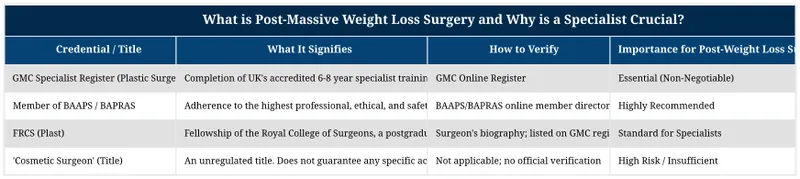
View data as table
| Credential / Title | What It Signifies | How to Verify | Importance for Post-Weight Loss Surgery |
|---|---|---|---|
| GMC Specialist Register (Plastic Surgery) | Completion of UK’s accredited 6-8 year specialist training programme in plastic and reconstructive surgery. | GMC Online Register | Essential (Non-Negotiable) |
| Member of BAAPS / BAPRAS | Adherence to the highest professional, ethical, and safety standards in the UK. | BAAPS/BAPRAS online member directories | Highly Recommended |
| FRCS (Plast) | Fellowship of the Royal College of Surgeons, a postgraduate qualification indicating successful completion of specialist surgical exams. | Surgeon’s biography; listed on GMC register | Standard for Specialists |
| ‘Cosmetic Surgeon’ (Title) | An unregulated title. Does not guarantee any specific accredited surgical training. | Not applicable; no official verification | High Risk / Insufficient |
Beyond Qualifications: The Value of Reconstructive Experience and Patient Safety
Body contouring after bariatric surgery is reconstructive. The procedures involve reshaping tissues, managing extensive scars, and preserving blood supply over large areas. This requires skills from complex reconstructive work.
The Reconstructive Advantage: NHS Consultant Expertise
Many experienced UK plastic surgeons hold or have held NHS consultant posts. NHS work exposes a surgeon to complex reconstructive challenges, from trauma and cancer reconstruction to congenital conditions like cleft lip and palate. This experience is valuable for post-weight loss surgery.
A surgeon with a reconstructive background, such as Mr Khurram Khan, understands tissue viability, wound healing, and anatomical restoration. This expertise, gained through roles at major UK hospitals, leads to safer procedures and predictable, functional outcomes for patients undergoing extensive body contouring.
Prioritizing Patient Safety and Natural, Balanced Outcomes
Patient safety is the primary focus. This includes a pre-operative assessment to ensure suitability, a discussion of risks, and a safe, consultant-led care pathway. The surgical environment, anaesthetic team, and post-operative care plan are critical components of safety.
Aesthetically, the goal is natural, balanced, and well-proportioned results. An experienced surgeon works with you to understand goals and set realistic expectations for a harmonious outcome, avoiding an “operated” look. You can see examples of a surgeon’s work and read patient experiences on their testimonials page.
Navigating Your Consultation: Key Questions for Your Body Contouring Specialist
The consultation is for assessing a surgeon’s expertise and approach. It is a two-way conversation where your questions should be answered thoroughly. Prepare a list of questions.
What to Ask About Experience and Specific Procedures
Ask about the surgeon’s direct experience with patients like you. Post-bariatric surgery has unique challenges compared to standard aesthetic procedures. Find a surgeon who frequently performs these operations and understands their complexities.
Understanding the Surgical Plan and Recovery Process
A detailed surgical plan is crucial. Your surgeon should explain which procedures are recommended, why, and in what sequence. Combining procedures is common but must be done safely. Your surgeon should explain the rationale for staging operations versus performing them concurrently, based on your health and the surgery’s extent.
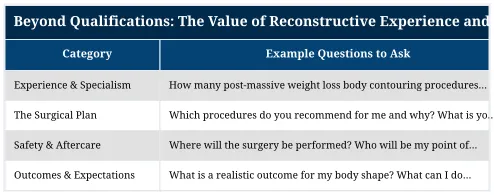
View data as table
| Category | Example Questions to Ask |
|---|---|
| Experience & Specialism | How many post-massive weight loss body contouring procedures do you perform each year? Do you have a particular focus (e.g., body lifts, arm lifts)? Can I see before-and-after photos of patients with similar starting points to mine? |
| The Surgical Plan | Which procedures do you recommend for me and why? What is your approach to combining procedures safely? Where will the scars be located, and how do you manage them? What are the specific risks I should be aware of? |
| Safety & Aftercare | Where will the surgery be performed? Who will be my point of contact after the operation? What does the follow-up care schedule look like? Who manages any potential complications? |
| Outcomes & Expectations | What is a realistic outcome for my body shape? What can I do to help achieve the best possible result? How long should I expect the recovery to take before I can return to work and exercise? |
Achieving Your Transformation: What to Expect from Post-Weight Loss Surgery
Body contouring surgery requires planning and commitment. Understanding the process helps ensure a positive experience. The journey is a partnership built on clear communication and shared goals.
The Journey from Consultation to Recovery
The journey begins with a consultation to review medical history, discuss goals, and perform a physical examination. If you are a suitable candidate, a surgical plan is created. You will receive pre-operative instructions on nutrition and medications.
Surgery is performed under general anaesthesia in a hospital. After the procedure, you are monitored in a recovery area. Initial recovery involves managing discomfort, wearing compression garments, and restricting physical activity. Follow-up appointments are crucial to monitor healing. You can explore potential procedures to understand the options.
Long-Term Outcomes and Maintaining Your Results
Excess skin removal can improve physical comfort and self-confidence. Scars are permanent, but a skilled surgeon places incisions strategically to minimise their visibility. Scars fade and mature over many months.
Maintaining your results requires long-term commitment. A stable weight is the most important factor, as significant fluctuations can compromise the outcome. Continuing the healthy diet and active lifestyle that led to your weight loss is key to maintaining results.
Connect with a UK Consultant Plastic Surgeon
Choosing the right surgeon is the most important decision in your body contouring journey. Focus on verifiable credentials like the GMC Specialist Register, a strong reconstructive background, and aligned goals to proceed with confidence.
To discuss your options with a UK-trained Consultant Plastic, Reconstructive and Aesthetic Surgeon, contact us to arrange a consultation. Request a body contour consultation to begin your journey.
Conclusion
Choosing a post-massive weight loss surgeon requires focusing on safety, qualifications, and reconstructive expertise. Confirming your surgeon is on the GMC Specialist Register for Plastic Surgery is the most critical step. This verification, a thorough consultation, and aligned aesthetic goals provide the foundation for a safe, successful outcome. Selecting the right surgical partner ensures a positive final chapter to your weight loss story.
To discuss your needs, Request a body contour consultation.
Frequently Asked Questions
What is the single most important qualification for a UK body contouring surgeon?
The most critical qualification is inclusion on the General Medical Council (GMC) Specialist Register for Plastic Surgery. This is the official, verifiable register confirming a surgeon has completed years of accredited UK training in plastic and reconstructive surgery. This level of training is essential for safely performing complex post-weight loss procedures.
Why is BAAPS or BAPRAS membership important when choosing a surgeon?
Membership in the British Association of Aesthetic Plastic Surgeons (BAAPS) or the British Association of Plastic, Reconstructive and Aesthetic Surgeons (BAPRAS) is a key indicator of a surgeon’s commitment to the highest professional standards. These organisations have a strict code of ethics and practice, ensuring members are vetted, fully accredited plastic surgeons dedicated to patient safety.
How does an NHS consultant role relate to finding the best post massive weight loss surgeon for private care?
A substantive NHS consultant post often indicates extensive experience in complex reconstructive surgery, not just routine cosmetic procedures. Surgeons in these roles frequently manage challenging cases involving tissue reconstruction, which provides a deep skill set directly applicable to the demands of body contouring. This background is a strong marker of a surgeon’s ability to handle the unique complexities of post-bariatric patients.
When reviewing before-and-after photos, what should I look for besides the overall change?
Beyond the general improvement, look for specifics that demonstrate surgical skill, such as the quality and placement of scars, the smoothness of the new contours, and the natural appearance of landmarks like the belly button. A skilled surgeon’s portfolio will show consistently good results across a variety of body types and procedures, not just one or two ideal outcomes.
Can I have multiple body contouring procedures at the same time after weight loss?
Combining procedures is common, but safety is the primary consideration. A responsible surgeon will assess your health and the extent of the proposed surgery based on guidelines from bodies like BAPRAS. Often, procedures are “staged,” meaning they are performed in separate operations to minimise risks and allow for a smoother recovery.
How long should my weight be stable before I am eligible for body contouring surgery?
Most surgeons recommend that your weight be stable for at least six months, and ideally longer, before undergoing surgery. This ensures that your nutritional status is optimised for healing and that the results of the contouring will be more predictable and long-lasting. Operating before weight stability can compromise both safety and the final aesthetic outcome.