
Prepare for Body Contouring Consultation: Ask Better Questions
To prepare for body contouring consultation appointments after massive weight loss, gather your medical history, rank your surgical goals and write a list of questions for the surgeon. This guide explains how weight stability, excess skin across several areas and any bariatric surgery shape the discussion. It includes a patient checklist, outlines what happens in a plastic surgery consultation and describes how a surgical plan and combined procedures are considered.
Mr Khurram Khan is a UK-trained Consultant Plastic Reconstructive and Aesthetic Surgeon on the GMC Specialist Register. His practice includes post massive weight loss body contouring, and this guide reflects that reconstructive approach.
To explore your options, contact us to schedule your consultation. You can also reach us via: Request a body contour consultation
How Do You Prepare for a Body Contouring Consultation?
To prepare for body contouring consultation appointments, focus on three things: clear goals, a complete medical history and a written list of questions. A consultant leads the consultation, assessing your health, excess skin and priorities so a personalised surgical plan can be discussed.
- Define and rank your surgical goals. List every area of concern in order of priority.
- Gather your medical history. Include details of any bariatric surgery and a list of your current medications.
- Note your weight loss journey. Record how much weight you lost and how stable your weight is now.
- Write down your questions for the surgeon. Cover qualifications, scars, recovery and aftercare.
- Wear comfortable, easy-to-remove clothing. The surgeon will need to examine the affected areas.
- Bring a trusted companion and a notebook. A second set of ears helps you remember the details.
The sections below explain each step and why it matters after significant weight loss.
A Quick Definition: What the First Appointment Involves
The first appointment is a two-way conversation, not a sales meeting. It usually includes a review of your medical history and a physical examination of the areas of excess skin. You will also discuss the options available and, with your consent, clinical photographs will be taken. For a full walkthrough, read what to expect from your post-bariatric plastic surgery consultation.
Why Preparation Matters After Massive Weight Loss
A consultation for a single cosmetic concern often focuses on one area. After massive weight loss, the changes are usually spread across the body. The abdomen, arms, thighs, chest and back may all show skin laxity. One appointment may therefore need to cover several regions, your general health and the order in which procedures could happen.
Your overall health also shapes whether surgery is suitable and when it should take place. Surgeons generally prefer your weight to have been stable for a sustained period before operating, because further weight change can alter the result. The NHS sets out useful things to consider before cosmetic surgery, and many apply directly to post-bariatric patients.
Good preparation also helps the surgeon judge whether procedures can be combined safely or should be staged. The table below compares the two approaches in general terms. Your own surgeon will advise on which suits you.

View data as table
| Approach | Often considered when | Trade-off | What to prepare |
|---|---|---|---|
| Combined procedures | General health is good and the areas treated are limited in extent | Fewer anaesthetics and recoveries, but a longer single operation and a more demanding recovery | Plan for more help at home during one recovery period |
| Staged procedures | Several large areas are involved, or health factors favour shorter operations | Each operation is smaller, but the overall journey takes longer and involves more visits | Rank your priorities so the most important area is treated first |
Weight Stability, Nutrition and Your Medical History
The surgeon will need an accurate picture of your health. Prepare notes on the following:
- Bariatric surgery details: the type (gastric bypass, sleeve or band) and the date. Some procedures affect how you absorb nutrients, and nutrition affects wound healing.
- Your weight loss journey: your highest weight, your current weight and how long it has been steady.
- Long-term conditions: diabetes, high blood pressure or any history of blood clots. These influence anaesthetic safety and healing.
- Medications and supplements: include vitamins and herbal products, because some affect bleeding.
- Allergies, previous operations and anaesthetic experiences.
- Smoking or vaping status: nicotine reduces blood flow to the skin, which can impair wound healing.
Do not stop any prescribed medication before the consultation unless your own doctor tells you to. Bring a full list instead. Any changes needed before surgery can be agreed later.
Functional Concerns Versus Aesthetic Goals
Excess skin can cause practical problems as well as concerns about appearance. Functional issues include skin irritation, recurrent rashes, hygiene difficulties, restricted movement, difficulty exercising and poorly fitting clothes. Aesthetic goals relate to contour, proportion and confidence.
Describe both clearly. Functional problems often point the surgeon towards a reconstructive approach to planning. Aesthetic goals help shape the final contour. NHS and private pathways differ, and NHS funding criteria vary by region. Mentioning functional symptoms does not guarantee eligibility for NHS treatment.
Your Consultation Prep Checklist: What to Bring and Ask
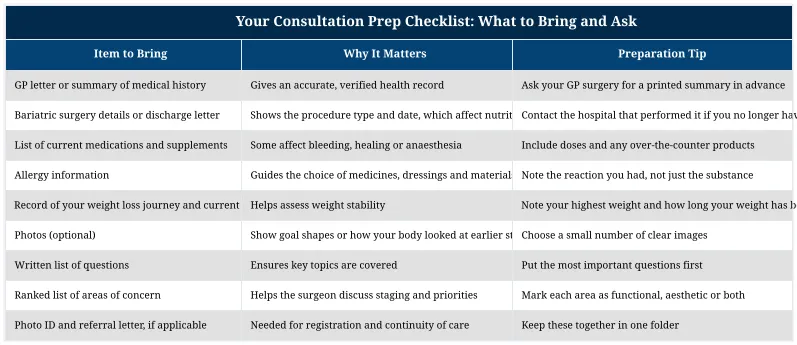
Consultation time is limited. A written patient checklist is the simplest way to prepare for body contouring consultation discussions and make sure nothing is missed.
View data as table
| Item to Bring | Why It Matters | Preparation Tip |
|---|---|---|
| GP letter or summary of medical history | Gives an accurate, verified health record | Ask your GP surgery for a printed summary in advance |
| Bariatric surgery details or discharge letter | Shows the procedure type and date, which affect nutrition and timing | Contact the hospital that performed it if you no longer have the letter |
| List of current medications and supplements | Some affect bleeding, healing or anaesthesia | Include doses and any over-the-counter products |
| Allergy information | Guides the choice of medicines, dressings and materials | Note the reaction you had, not just the substance |
| Record of your weight loss journey and current weight | Helps assess weight stability | Note your highest weight and how long your weight has been steady |
| Photos (optional) | Show goal shapes or how your body looked at earlier stages | Choose a small number of clear images |
| Written list of questions | Ensures key topics are covered | Put the most important questions first |
| Ranked list of areas of concern | Helps the surgeon discuss staging and priorities | Mark each area as functional, aesthetic or both |
| Photo ID and referral letter, if applicable | Needed for registration and continuity of care | Keep these together in one folder |
Wear loose, comfortable clothing that is easy to remove. Simple, supportive underwear can help you feel more at ease during the examination. A trusted companion can take notes while you focus on the conversation.
How to Define and Rank Your Surgical Goals
- Stand in front of a full-length mirror in good light.
- List every area that bothers you, such as the abdomen, upper arms, thighs, chest or back.
- Beside each area, write whether the concern is functional, aesthetic or both.
- Rank the areas from most to least important.
- Note one sentence on what improvement would mean for daily life.
Photos can help you communicate direction, but they are not a guaranteed result. Body contouring involves a trade-off: looser skin is exchanged for scars, and results vary between individuals. A common mistake is ranking areas only by appearance. A rash under an abdominal apron may matter more day to day than arm contour.
Questions for Your Surgeon You Should Write Down
- Are you on the GMC Specialist Register for Plastic Surgery?
- How often do you perform post weight loss body contouring?
- Which procedures would you recommend for my priorities, and why?
- Can any procedures be combined safely, or should they be staged?
- Where will the scars be?
- What does recovery involve, and how much support will I need at home?
- Where will surgery take place, and who provides aftercare?
- What happens if I need a revision?
You can check any doctor’s registration and specialist status on the General Medical Council medical register.
How Mr Khurram Khan Approaches Post Weight Loss Consultations
Mr Khurram Khan is a fully UK-trained Consultant Plastic, Reconstructive and Aesthetic Surgeon. He graduated from King’s College Medical School with distinction in 2004, with a first class honours BSc. He completed specialist plastic surgery training in Oxford and holds the FRCS (Plastic Surgery). He is on the GMC Specialist Register for Plastic Surgery.
His training includes a BAAPS cosmetic surgery fellowship and a fellowship in microsurgical breast reconstruction. He is a member of BAPRAS, BAAPS and CFSGBI. He has held substantive NHS consultant posts at Queen Elizabeth Hospital Birmingham and Birmingham Children’s Hospital.
This reconstructive background is relevant to post massive weight loss patients, whose concerns often involve function, proportion and tissue quality as well as appearance. His philosophy centres on safe, tried and tested techniques and natural, well-proportioned results.
Enquiries are handled through his private secretary, giving you a clear point of contact before and after your plastic surgery consultation. Patient feedback includes an I Want Great Care rating of 4.9 from 84 reviews and a RealSelf rating of 4.9 from 38 reviews.
A Reconstructive Perspective on Excess Skin and Body Contouring
After major weight loss, one area is rarely assessed in isolation. Mr Khan looks at the whole body. He then discusses priorities, safety, possible staging and recovery as one connected surgical plan. For example, a patient may want abdominoplasty, an arm lift (brachioplasty) and a thigh lift. The discussion then covers which area matters most, what can safely be combined and how recovery would affect daily life.
You can explore post massive weight loss surgery options and related procedures before your appointment.
What Should You Expect After Your First Appointment?
The first appointment is the start of a process, not a commitment. Next steps usually include:
- A written summary or letter outlining the proposed surgical plan, the options discussed and the risks.
- Time to reflect before deciding. GMC guidance on cosmetic interventions expects patients to have time to consider their decision without pressure.
- A possible second consultation to confirm details, review your questions and finalise the plan.
- Pre-operative assessment if you decide to go ahead, which may include blood tests and health checks.
- Practical recovery planning: time off work, help at home, transport, childcare and support with lifting.
Review your notes soon after the appointment while the details are fresh. Compare the proposed plan against your ranked goals. If new questions come up, raise them with the private secretary rather than waiting.
You can also confirm that the hospital or clinic where surgery will take place is registered with the Care Quality Commission (CQC), the independent regulator of health services in England.
Using the Reflection Period to Make a Confident Decision
The reflection period is a strength of a safe, consultant-led process, not a delay. Use it actively:
- Re-read the surgical plan and the written summary.
- Check that your top-ranked priorities are addressed.
- Discuss the plan with family or the people who will support your recovery.
- Prepare follow-up questions about anything unclear.
- Think honestly about scar placement and recovery commitments.
After a long weight loss journey, it is natural to feel emotional about this stage. Feeling ready means accepting the trade-offs, not only looking forward to the benefits.
Request a Body Contouring Consultation in Birmingham
If your weight is stable and you would like a reconstructive, consultant-led assessment, Mr Khurram Khan offers consultations at private hospital locations across the West Midlands. These serve patients from Birmingham, Little Aston, Sutton Coldfield, Solihull and the wider Midlands.
Once you have used this guide to prepare for body contouring consultation questions and paperwork, bring your checklist with you. Enquiries are handled through his private secretary.
Request a body contour consultation or visit the main website to learn more.
Conclusion
Before booking, try a simple test. Can you name your top two priorities? Can you explain your weight loss journey and how long your weight has been stable? Have you confirmed your surgeon’s GMC specialist registration? If so, you are ready for a productive first appointment. If not, those are the gaps to fill first.
After the consultation, judge the plan by whether it addresses your ranked priorities safely, not by how many areas it covers. When you are ready, Request a body contour consultation or contact us.
Frequently Asked Questions
How stable should my weight be before a body contouring consultation?
You can attend a consultation at any point, but surgeons generally prefer your weight to have been stable for a sustained period before operating, because further weight change can alter the result. Many UK surgeons and bariatric services commonly refer to a stable weight of around 12 to 18 months after weight loss surgery, though this varies between individuals. Noting your current weight, your lowest weight and any recent fluctuations will help a consultant advise on timing.
What bariatric surgery details should I bring to my appointment?
Bring the type of procedure (for example gastric bypass, sleeve gastrectomy or gastric band), the date, and your starting and current weight. Also include any recent blood results, particularly for haemoglobin, ferritin, vitamin B12 and protein, as nutritional deficiencies can affect wound healing. Discharge letters or a summary from your bariatric team are useful if you have them.
Do I need to stop smoking or vaping before I prepare for body contouring consultation?
You do not need to stop before the consultation, but you should be honest about nicotine use in any form, including vaping and patches. Nicotine restricts blood flow to the skin and increases the risk of wound-healing problems, so surgeons commonly ask patients to stop well ahead of surgery. Disclosing this early allows a realistic plan to be agreed.
Can I discuss several procedures in one consultation, such as tummy tuck and arm lift?
Yes, and it is helpful to prepare for body contouring consultation by ranking the areas that bother you most. Surgeons assess whether combining procedures is safe, considering operating time, your general health, BMI and the demands of recovery. Many patients after massive weight loss need staged operations rather than everything at once, and the consultant will explain the reasoning for any proposed order.
Should I check my surgeon’s registration before the consultation?
Yes. In the UK, you can search the General Medical Council (GMC) Specialist Register to confirm a surgeon is listed for plastic surgery. Professional memberships such as BAAPS and BAPRAS, and the FRCS (Plast) qualification, offer further reassurance of specialist training. Mr Khurram Khan is on the GMC Specialist Register for Plastic Surgery.
Will I be examined or photographed at a first consultation?
A physical examination is usual, as the surgeon needs to assess skin quality, fat distribution, existing scars and any skin problems such as rashes under skin folds. Clinical photographs are often taken for your medical record and planning, and are stored under UK data protection rules with your consent. Wearing comfortable underwear or loose clothing that is easy to adjust makes this part more straightforward.