

Cleft Rhinoplasty Patient Journey: Navigating Specialist Reconstructive Care
The cleft rhinoplasty patient journey outlines the comprehensive process for individuals seeking nasal correction following a cleft lip and palate. This article details the unique aspects of cleft rhinoplasty, distinguishing it from standard nose surgery by focusing on reconstructive surgery to address complex nasal deformity. Readers will understand the stages from initial consultation and bespoke surgical planning, through the procedure and post-operative care, to achieving improved nasal symmetry and facial harmony. The journey emphasizes specialist expertise required for optimal functional and aesthetic outcomes.
Mr. Khurram Khan, an NHS Consultant Plastic Reconstructive and Aesthetic Surgeon, brings specialist training in cleft lip and palate surgery to complex rhinoplasty cases. His approach prioritizes both functional improvement and natural aesthetic results, ensuring comprehensive care throughout the patient’s experience.
To explore your options, contact us to schedule your consultation. You can also reach us via: Enquire about cleft rhinoplasty
Understanding the Cleft Rhinoplasty Patient Journey
Cleft rhinoplasty is a specialised surgical procedure that corrects nasal shape and improves function for individuals born with a cleft lip and palate. It is a collaboration between patient and surgeon through distinct stages to achieve a symmetrical, functional, and aesthetically balanced nose.
The cleft rhinoplasty patient journey has several phases:
- Initial Consultation: A thorough assessment of your nasal anatomy, breathing function, and aesthetic goals with a specialist surgeon.
- Bespoke Surgical Planning: Development of a detailed, individualised surgical plan that may involve advanced techniques like cartilage grafting.
- The Surgical Procedure: The operation itself, performed under general anaesthesia by an expert reconstructive team.
- Post-Operative Recovery: A carefully managed healing period, starting with splints and dressings and progressing through stages of swelling reduction.
- Long-Term Follow-Up & Final Results: A series of follow-up appointments to monitor healing as the final, refined nasal shape emerges over many months.
What is Cleft Rhinoplasty?
Unlike standard cosmetic rhinoplasty, cleft rhinoplasty is a reconstructive procedure. It addresses the structural and aesthetic challenges of the nasal deformity from a cleft lip and palate. The primary goals are to improve nasal breathing by correcting internal structures like a deviated septum and to create external symmetry and support, improving facial harmony.
Why Cleft Rhinoplasty is Unique: Beyond Standard Nose Surgery
Nasal challenges from a cleft lip and palate are more complex than those in conventional nose reshaping. The underlying anatomy is different, requiring a reconstructive approach that builds and supports structure, rather than reducing or refining existing features. This complexity requires specialist training.
Anatomical Challenges & Functional Considerations
In a cleft-related nasal deformity, the nasal cartilage and bone are often underdeveloped, asymmetric, and poorly positioned. Common characteristics include:
- Alar Cartilage Asymmetry: The cartilage forming the nostril on the cleft side is typically flattened, wider, and lower than the non-cleft side.
- Septal Deviation: The septum (the wall dividing the nostrils) is almost always significantly deviated, often obstructing the airway on one or both sides.
- Columellar Shortening: The columella, the strip of tissue between the nostrils, is often short and pulled towards the cleft side.
- Depressed Nasal Tip: The tip of the nose lacks support and projection, appearing droopy or flattened.
- Wide Nasal Base: The base of the nose on the cleft side is often wider and displaced.
Addressing these issues requires the surgeon to improve the nose’s appearance and reconstruct the airway for better breathing. The procedure balances form and function.
The Role of Cartilage Grafting in Reconstruction
Cleft nose surgery frequently requires cartilage grafts. Because existing nasal cartilage is often weak and insufficient, the surgeon borrows cartilage from other parts of the body (donor sites) to build a stable framework. Common donor sites include the nasal septum, ear (conchal cartilage), or rib (costal cartilage). These grafts are carved and placed to create support, define the nasal tip, straighten the bridge, and improve nostril symmetry.
View data as table
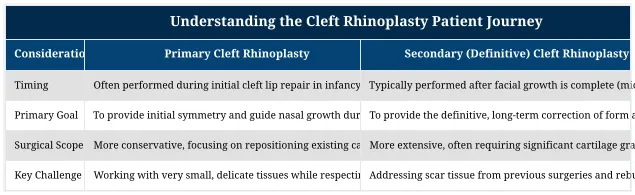
| Consideration | Primary Cleft Rhinoplasty | Secondary (Definitive) Cleft Rhinoplasty |
|---|---|---|
| Timing | Often performed during initial cleft lip repair in infancy. | Typically performed after facial growth is complete (mid-to-late teens). |
| Primary Goal | To provide initial symmetry and guide nasal growth during childhood. | To provide the definitive, long-term correction of form and function. |
| Surgical Scope | More conservative, focusing on repositioning existing cartilage. | More extensive, often requiring significant cartilage grafting and structural reconstruction. |
| Key Challenge | Working with very small, delicate tissues while respecting future growth. | Addressing scar tissue from previous surgeries and rebuilding a deficient framework. |
Your Cleft Rhinoplasty Consultation & Surgical Planning
A thorough consultation and surgical plan are the foundation for a successful outcome. During this collaborative process, you and your surgeon establish realistic goals and map the surgical steps.
The First Step: Comprehensive Assessment and Discussion
Your initial consultation is a detailed discussion. Mr. Khan will review your medical and surgical history, particularly previous cleft-related surgeries. He will perform a physical examination of the external and internal nose to assess skin quality, cartilage strength, septal position, and airway patency.
You will discuss your goals, including functional issues like breathing difficulty and aesthetic concerns about nasal shape and symmetry. This communication ensures the surgical plan aligns with your goals. Enquire about cleft rhinoplasty to schedule your initial assessment.
Crafting Your Bespoke Surgical Plan
Because no two cleft nasal deformities are identical, every surgical plan is bespoke. A detailed strategy is formulated from your assessment and goals. The plan outlines required techniques, such as the incision type (typically an ‘open’ approach for visibility), the source and use of cartilage grafts, and septoplasty steps.
Clinical photography documents the preoperative state and aids planning. The surgeon will explain the procedure’s sequence, expected recovery, and potential risks, so you are fully informed.
View data as table
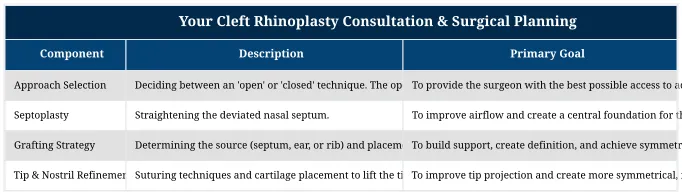
| Component | Description | Primary Goal |
|---|---|---|
| Approach Selection | Deciding between an ‘open’ or ‘closed’ technique. The open approach is most common in cleft cases for maximum exposure. | To provide the surgeon with the best possible access to address complex structural issues. |
| Septoplasty | Straightening the deviated nasal septum. | To improve airflow and create a central foundation for the external nose. |
| Grafting Strategy | Determining the source (septum, ear, or rib) and placement of cartilage grafts. | To build support, create definition, and achieve symmetry where native cartilage is weak or missing. |
| Tip & Nostril Refinement | Suturing techniques and cartilage placement to lift the tip and reshape the alar cartilages. | To improve tip projection and create more symmetrical, naturally shaped nostrils. |
The Specialist Advantage: Mr. Khurram Khan’s Approach
A successful cleft rhinoplasty depends on the surgeon’s expertise. This complex reconstructive surgery demands a deep understanding of cleft anatomy, advanced surgical techniques, and a focus on natural, functional, and lasting results.
Expertise in Cleft & Reconstructive Plastic Surgery
Mr. Khurram Khan is a UK-trained Consultant Plastic, Reconstructive, and Aesthetic Surgeon on the GMC Specialist Register for Plastic Surgery. His expertise comes from extensive training and experience within the NHS, including a consultant post at Birmingham Children’s Hospital, a world-renowned centre for cleft care. This role involves managing complex primary and secondary cleft cases.
This background gives him an understanding of the challenges of cleft anatomy and scar tissue from previous operations. His approach integrates reconstructive principles with an aesthetic eye to restore form and function. Learn more about his qualifications and background on his biography page.
A Patient-Centred Philosophy for Optimal Outcomes
Mr. Khan’s practice is based on safety, transparency, and achieving balanced results that respect patient individuality. He is a full member of professional bodies such as the British Association of Plastic, Reconstructive and Aesthetic Surgeons (BAPRAS) and the British Association of Aesthetic Plastic Surgeons (BAAPS), adhering to high standards of care and ethics.
The process is consultant-led from the first call to the final follow-up. This ensures continuity of care and clear communication, keeping patients supported and informed. The goal is to restore harmony and confidence with a structurally sound and aesthetically pleasing result, not an “operated” look.
Begin Your Journey to Nasal Harmony with a Cleft Rhinoplasty Specialist
Cleft rhinoplasty is a significant decision. Choosing a surgeon with expertise in cleft and reconstructive surgery is critical for a successful outcome that improves breathing and confidence. A specialist has the technical skill to address the challenges of the cleft nose.
Why Choose Mr. Khurram Khan for Your Cleft Rhinoplasty?
Mr. Khan’s experience as an NHS Consultant in a major cleft centre, combined with his commitment to natural, patient-centred results, is an advantage. His approach is tailored to your anatomy and goals, creating a plan to restore nasal form and function. If you are considering cleft nose surgery, seek an expert consultation.
To learn more and begin your journey, Enquire about cleft rhinoplasty.
Conclusion
Correcting a cleft-related nasal deformity is a detailed process requiring a surgeon with a deep understanding of cleft anatomy, reconstructive principles, and a commitment to long-term functional and aesthetic results. Selecting a surgeon with training and experience in these challenges is the most important decision. A successful outcome enhances facial harmony and improves quality of life through better nasal function. Your next step is to get personalised information from a specialist.
To discuss your needs, contact us or Enquire about cleft rhinoplasty to arrange a consultation.
Frequently Asked Questions
At what age is cleft rhinoplasty usually performed?
Cleft rhinoplasty is typically recommended after facial growth is largely complete, which is usually in the mid-to-late teenage years. Performing complex nasal surgery before this point can interfere with the nose’s natural development. A specialist surgeon assesses skeletal maturity to determine the optimal timing for each individual.
How does previous cleft lip surgery affect the rhinoplasty procedure?
Prior cleft lip repairs create scar tissue and alter the anatomy of the nasal base and upper lip, which must be meticulously addressed. A surgeon with advanced training in cleft procedures, often a member of the Craniofacial Society of Great Britain and Ireland (CFSGBI), has the expertise to navigate this existing scar tissue to successfully reshape the nose.
Why is cartilage grafting so common in cleft nose correction?
In cleft-related nasal deformities, the cartilage forming the nose is often weak, underdeveloped, and positioned asymmetrically. Cartilage grafts, typically harvested from the patient’s own septum, ear, or rib, are essential for building a strong, stable framework to support the new nasal shape and improve symmetry.
How are breathing problems addressed alongside cosmetic changes?
Functional improvement is a primary goal. The procedure almost always includes a septoplasty to straighten a deviated septum, which is common in cleft patients. The surgeon also uses structural grafting techniques to support and open collapsed or narrowed nasal passages, improving airflow (nasal patency) while simultaneously enhancing the nose’s external form.
What makes the recovery timeline for cleft rhinoplasty different from a standard nose job?
The recovery can be more prolonged due to the reconstructive complexity and extensive use of grafts. While the initial cast comes off after about a week, the final, refined result of the cleft rhinoplasty patient journey can take 18 months or even longer to fully emerge as significant swelling in the thicker skin and grafted areas gradually subsides.
Is a revision cleft rhinoplasty significantly more complex?
Yes, revision surgery is considerably more challenging due to internal scar tissue from the primary operation and a potentially limited supply of cartilage for grafting. This complexity requires a surgeon with specific expertise in both revision and cleft techniques. A thorough and well-executed primary surgery is crucial for minimising the need for future revisions.


